Introduction
Choosing the right printing technique is an important decision for custom sportswear brands, sports clubs, and wholesale buyers. Two popular methods are sublimation printing and screen printing.
Both techniques offer different benefits in terms of design flexibility, fabric compatibility, durability, and production cost. Understanding these differences can help you make better decisions when ordering custom sportswear in bulk.
1. What Is Sublimation Printing?
Sublimation printing uses heat to transfer special dyes into compatible fabric fibers. It is particularly suitable for polyester-based performance sportswear.
Benefits of Sublimation Printing
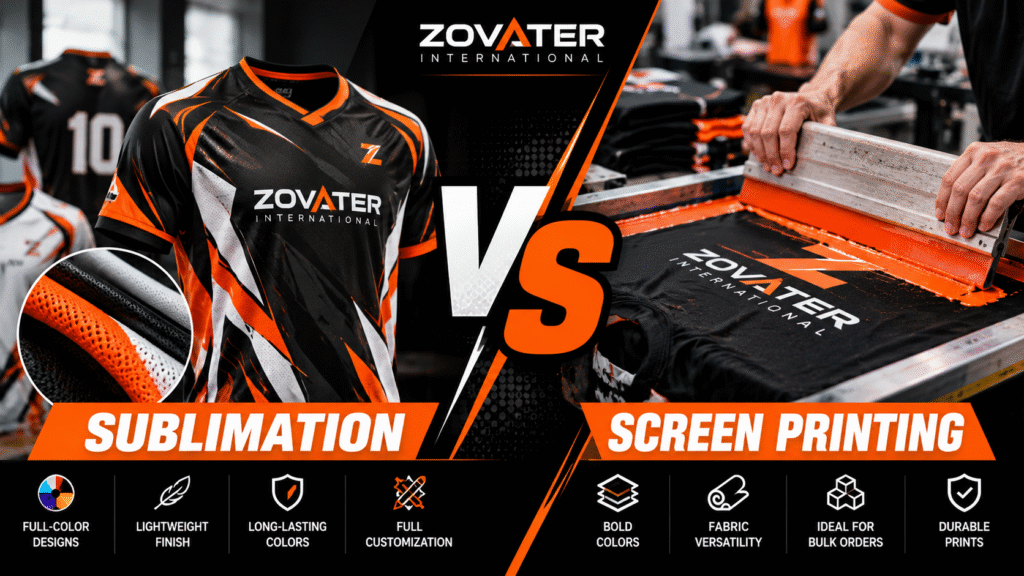
- Full-Color Designs: Ideal for detailed graphics, gradients, and all-over patterns.
- Lightweight Finish: The design does not create a thick ink layer on the fabric.
- Long-Lasting Colors: Properly produced sublimated designs resist cracking and peeling.
- Customization: Suitable for team names, player numbers, logos, and personalized uniforms.
Best Applications
Sublimation printing is commonly used for:
- Soccer jerseys
- Basketball uniforms
- Cycling jerseys
- Volleyball uniforms
- Custom teamwear
Important: Standard dye sublimation works best on white or light-colored polyester fabrics. Dark garments and cotton generally require other approaches.
2. What Is Screen Printing?
Screen printing uses a mesh screen and stencil to apply ink onto the surface of a garment.
It is a popular choice for bold logos, solid graphics, and repeat production runs.
Benefits of Screen Printing
- Vibrant Colors: Produces strong, bold designs.
- Fabric Versatility: Suitable for many cotton, polyester, and blended garments when appropriate inks are used.
- Bulk Production: Can be cost-effective for repeated designs and larger quantities.
- Durability: Properly cured prints can withstand repeated washing.
Best Applications
Screen printing works well for:
- Training T-shirts
- Team practice shirts
- Sportswear merchandise
- Hoodies and sweatshirts
- Promotional apparel
3. Sublimation vs Screen Printing: Key Differences
| Feature | Sublimation Printing | Screen Printing |
|---|---|---|
| Best fabric | Suitable polyester fabrics | Cotton, polyester, and blends |
| Design complexity | Excellent for gradients and detailed artwork | Excellent for bold, repeatable graphics |
| Print feel | Minimal surface texture | Ink layer may be noticeable |
| Dark garments | Limited with conventional dye sublimation | Suitable with appropriate inks |
| Bulk production | Depends on design and workflow | Often economical for large runs with few colors |
| Durability | Dye becomes part of compatible fibers | Depends on ink, curing, and care |
4. Which Printing Method Is Better for Sportswear?
There is no single method that is best for every product.
Choose sublimation printing when:
- You need full-color custom jerseys.
- Your designs contain gradients or complex patterns.
- You are producing suitable polyester sportswear.
- You want player-specific designs without a heavy printed surface.
Choose screen printing when:
- You need simple logos or bold graphics.
- You are printing on cotton or suitable blended fabrics.
- You want consistent designs across large production runs.
- You are producing training apparel, hoodies, or merchandise.
5. Consider Production Costs and Order Quantity
Printing costs depend on several factors, including:
- Fabric composition
- Number of print colors
- Design size and coverage
- Order quantity
- Artwork preparation
- Production and finishing requirements
Screen printing usually involves screen setup costs, but the cost per garment can become attractive as order quantities increase.
Sublimation can be convenient for detailed designs and personalized garments, although total costs depend on the specific production process.
For an accurate comparison, request quotations based on the same garment specifications and order quantity.
6. How to Choose the Right Manufacturing Partner
Before placing a bulk sportswear order, discuss these requirements with your manufacturer:
- Fabric type and GSM
- Printing method compatibility
- Sample approval process
- Design and color requirements
- Minimum order quantity
- Production lead times
- Quality control standards
Requesting physical samples can help you evaluate print finish, comfort, wash performance, and overall product quality before bulk production.
Conclusion
Both sublimation and screen printing play important roles in custom sportswear manufacturing.
Sublimation printing is often the better choice for detailed, full-color polyester teamwear.
Screen printing can be ideal for bold designs, promotional sportswear, and large production runs.
The right choice depends on your fabric, design, budget, and intended use.
Zovater International works with businesses seeking custom sportswear manufacturing solutions.
Looking to develop your next custom sportswear collection? Contact Zovater International to discuss fabric, printing, and customization requirements.